
Alternative Cooling Solutions for Engineers: 2026 Guide


Prioritize passive load reduction first, then site-appropriate active alternatives: ductless/inverter vapor-compression with low-GWP refrigerants for most U.S. climates, evaporative cooling in dry regions, and solid-state or immersion cooling for electronics. The AIM Act and its Kigali Amendment roots make refrigerant selection a compliance decision, not just a performance one. Your immediate next step: run a baseline thermal model (steady-state first, then transient) and a parametric sweep comparing COP, SEER2/CEER, part-load efficiency, and humidity impact across candidate technologies. Jewlztech’s Thermalysis Toolkit is built for exactly that workflow.
Before you shortlist any system, confirm these inputs are in your model:
Climate zone and representative meteorological year (TMY) data
Internal heat gains, occupancy schedules, and latent load estimates
Refrigerant GWP targets aligned with AIM Act phase-down timelines
Transient vs. steady-state decision (hybrid passive/active systems always need transient)
Validation plan: sensor data, mesh convergence targets, energy balance closure
Table of Contents
What alternative cooling solutions are available, and where does each fit?
Alternative Cooling Technologies (ACTs) span a wider range than most engineers initially model. The Carbon Containment Lab recognizes solid-state, magnetocaloric, radiative, and thermal-storage approaches as legitimate complements to low-GWP refrigerant swaps.
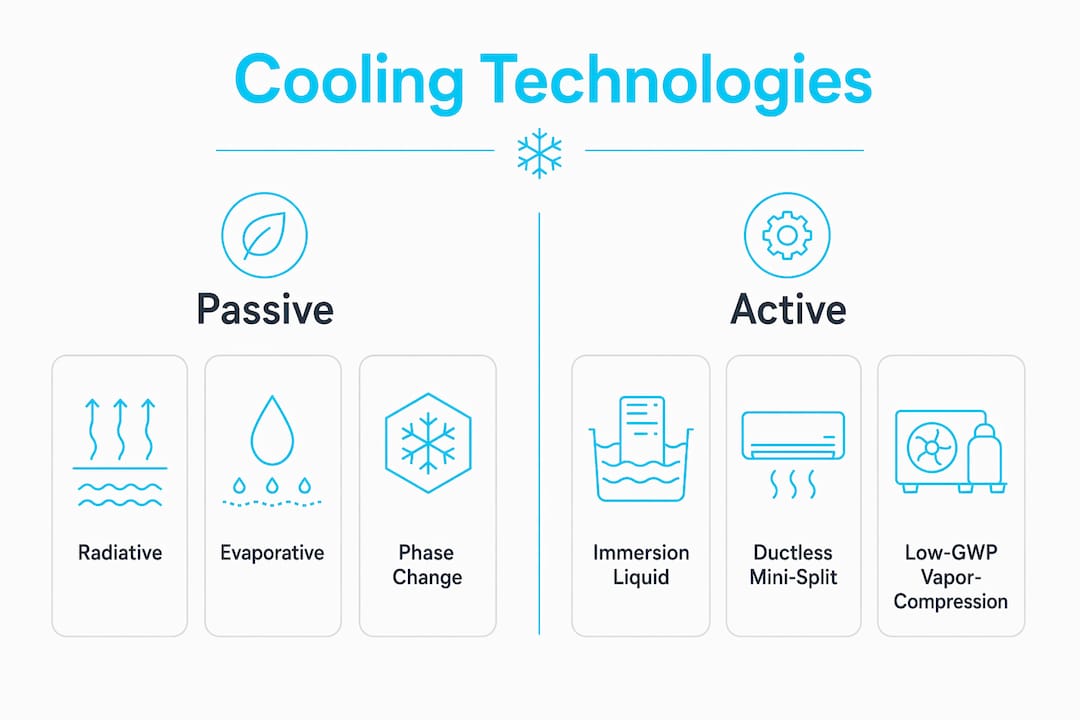
Passive systems (no compressor, lowest energy intensity):
Radiative cooling: Specialized roof or façade panels radiate heat to the sky. Laboratory tests with salt-based panels have shown surface cooling up to ~18°F below ambient. Best for low-humidity climates; requires material property data (emissivity, absorptivity) in your thermal model.
Phase-change materials (PCM): Absorb peak heat loads and release them during off-peak hours. Strong for diurnal climates; phase-change modeling adds complexity and requires accurate enthalpy-temperature curves.
Shading and ventilative cooling: Proper insulation and exterior shading can cut cooling demand by up to 80%, per IEA analysis. Natural ventilation can lower indoor temperatures substantially. Model these as boundary condition modifiers before sizing any active system.
Active non-vapor-compression systems:
Evaporative cooling: Up to 75% less energy than vapor-compression in dry climates. Fails where latent loads dominate. Humidity modeling is non-negotiable here.
Absorption/adsorption chillers: Waste-heat driven; COP typically 0.6–1.2 for single-effect. Best for industrial or district cooling with available heat sources.
Desiccant + evaporative hybrid: Separates sensible and latent loads; extends evaporative applicability into mixed-humid climates. Requires psychrometric node modeling.
Thermoelectric (Peltier): Solid-state, no moving parts, low COP (~0.3–0.6). Suited for precision electronics spot-cooling, not space conditioning.
Magnetocaloric / elastocaloric: Emerging; no refrigerant, high theoretical efficiency. Still pre-commercial for most applications; include as a sensitivity case in forward-looking models.
Immersion and liquid cooling: Direct liquid contact with electronics; highest heat flux removal. Standard for high-density data centers and power electronics. See heat exchanger modeling examples for immersion templates.
Low-GWP vapor-compression and ductless/inverter systems: Ductless mini-splits can achieve SEER2 ratings of 25+; high-efficiency central systems typically range 16–20 SEER2. Inverter window units can reach CEER 15+. These remain the workhorse for single-zone retrofits and most commercial applications. For EV battery thermal management, see Jewlztech’s battery thermal guide.

Technology | Climate Fit | Application | Key Simulation Input |
Radiative cooling | Dry, low humidity | Building envelope | Emissivity, sky temperature |
PCM thermal mass | High diurnal swing | Building/equipment | Enthalpy-temperature curve |
Evaporative cooling | Hot-dry | Space cooling | Psychrometrics, latent load |
Desiccant hybrid | Mixed-humid | Space cooling | Psychrometric nodes |
Absorption chiller | Any (waste heat) | District/industrial | COP curve, heat source temp |
Thermoelectric | Any | Electronics spot-cooling | Peltier coefficient, heat flux |
Immersion/liquid | Any | Data centers, EV batteries | Fluid properties, flow rate |
Ductless inverter | Any | Single-zone, retrofit | Part-load curve, SEER2 |
Which metrics and climate inputs should you simulate?
IEA analysis shows the average new air conditioner sold globally is only about half as efficient as the best available models, yet both can cost the same upfront. That gap is exactly what parametric simulation closes.
Metrics to capture in every comparative run:
COP, EER, SEER2, CEER (full-load and part-load curves)
Energy intensity (kWh/m² or kWh/unit at design conditions)
Lifecycle GWP (kg CO₂e) including refrigerant leak probability
Latent load fraction and humidity impact on comfort (PMV/PPD or adaptive metrics)
Peak demand contribution and control turn-down behavior
ASHRAE standards stress that latent loads and humidity must be coupled with thermal models, not treated as post-processing corrections. Evaporative and desiccant systems fail in simulation when this coupling is skipped.
Climate suitability matrix (qualitative):
Technology | Hot-Dry | Hot-Humid | Mixed | High-Diurnal |
Radiative cooling | Good | Conditional | Conditional | Good |
Evaporative cooling | Good | Poor | Conditional | Good |
Desiccant hybrid | Conditional | Good | Good | Conditional |
PCM thermal mass | Conditional | Poor | Good | Good |
Ductless inverter | Good | Good | Good | Good |
Absorption chiller | Good | Good | Good | Conditional |
Immersion/liquid | Good | Good | Good | Good |
How should you structure the simulation workflow and validation?
The workflow in one line: define baseline → build coupled models → run transient parametric sweeps → validate → compare lifecycle metrics. Transient analysis is required whenever passive measures or thermal mass interact with active systems; steady-state assumptions hide dynamic interactions that cause oversizing.
Define the baseline load. Set occupancy schedules, internal gains, envelope U-values, and infiltration rates. Use DOE TMY weather files for the target U.S. climate zone.
Set boundary conditions. Design-day dry-bulb and wet-bulb temperatures, solar irradiance profiles, and ground temperatures for slab or earth-coupled systems.
Choose transient vs. steady-state. Steady-state is acceptable only for simple single-zone electronics cooling with no thermal mass. Any building or hybrid system needs transient.
Couple building energy model with CFD. Use CFD for local effects: stratification, plume cooling, ventilation short-circuiting. The active vs. passive decision guide covers when CFD coupling adds value vs. when a lumped model suffices.
Model humidity and latent heat. Include psychrometric nodes, latent heat sources, and condensation checks. This is where evaporative and desiccant models most often fail peer review.
Input refrigerant and material thermo-physical data. Use NIST REFPROP or an equivalent built-in property database. Never rely on nameplate SEER2 alone; apply manufacturer part-load curves and envelope losses.
Model control strategy. Inverter speed, setpoint hysteresis, and economizer logic all shift part-load efficiency significantly.
Validate. Check mesh convergence, energy balance closure, and sensor-to-model agreement on a design-day. For evaporative/desiccant systems, verify condensate rates against measured or published benchmarks.
Pro Tip: Structure parametric sweeps as a factorial design: vary capacity, setpoint, control hysteresis, and outdoor humidity simultaneously. A common acceptance criterion for energy model validation is within 10% of measured energy use for annual totals and within 30% for peak demand, per ASHRAE Guideline 14 best practice.
What regulatory and lifecycle obligations affect refrigerant selection?
The AIM Act is the primary U.S. mechanism for phasing down high-GWP HFCs, implementing the Kigali Amendment domestically. It pushes engineers toward low-GWP alternatives or non-vapor-compression approaches from the design stage, not as a retrofit afterthought.
Lifecycle Refrigerant Management (LRM) is the part most specifications underweight. Swapping to a lower-GWP refrigerant achieves little if the system leaks, recovery is incomplete, or end-of-life handling is undocumented. Design for leak resistance: specify leak-detection instrumentation, pressure-test protocols, and documented recovery plans as contract requirements.
Practical spec language to include:
“Refrigerant GWP shall not exceed [target threshold] per AIM Act phase-down schedule applicable at time of installation.”
“System shall include continuous leak-detection instrumentation with alarm setpoints per ASHRAE Standard 15.”
“Contractor shall provide a documented refrigerant recovery and disposal plan prior to commissioning.”
One note on HFOs: while marketed as low-GWP, some HFO blends carry PFAS-related environmental concerns. Evaluate the full lifecycle profile, not just the GWP number.
Which tools and data sources support this workflow?
Engineers need four tool categories: whole-building energy models, CFD solvers for local flow effects, refrigerant/thermo-physical property libraries, and lifecycle/GWP calculators. For CFD tool selection in electronics and data center applications, Jewlztech’s data center CFD guide covers the main platform trade-offs.
Essential data sources:
DOE TMY weather files: Free, U.S.-specific, required for any ASHRAE-compliant load calculation
NIST REFPROP: The authoritative refrigerant and fluid property library for the U.S.; covers HFCs, HFOs, natural refrigerants, and blends
ASHRAE Fundamentals Handbook: Psychrometrics, load calculation methods, and comfort indices
Manufacturer part-load curves: Required for realistic COP modeling at off-design conditions
Thermalysis Toolkit (Jewlztech) covers the core simulation needs for this workflow: multi-mode heat transfer (conduction, convection, radiation), a built-in material and refrigerant property database, transient parametric sweep support, and phase-change material modeling. It runs as a downloadable Excel-based tool, which means no licensing server overhead and straightforward integration into existing project workflows. For teams evaluating passive-to-active coupling or running sensitivity studies on refrigerant substitutes, it handles the property data and parametric structure without requiring a separate CFD platform for every scenario.
Key Takeaways
Passive load reduction and transient parametric simulation are the two decisions that most determine whether an alternative cooling system performs as designed or gets oversized and underperforms in the field.
Point | Details |
Passive load reduction first | Shading and insulation can cut cooling demand by up to 80% before any active system is sized. |
Climate drives technology selection | Evaporative cooling saves up to 75% energy in dry climates but fails where latent loads dominate. |
Transient modeling is mandatory | Steady-state assumptions hide dynamic interactions and cause oversizing in hybrid systems. |
AIM Act shapes refrigerant choices | U.S. projects must align refrigerant GWP with AIM Act phase-down schedules from the design stage. |
Thermalysis Toolkit fits the workflow | Jewlztech’s toolkit supports multi-mode heat transfer, transient sweeps, and built-in property data for comparing alternative systems. |
The simulation gap most engineers still leave open
The most common mistake on alternative cooling projects is not choosing the wrong technology. It is running the wrong model type. Engineers shortlist evaporative or PCM systems based on steady-state load calculations, then discover during commissioning that the system cycles erratically or fails to meet humidity targets. The transient interaction research is clear: passive measures change peak timing, not just peak magnitude, and that shift breaks steady-state sizing assumptions.
The second mistake is treating humidity as a post-processing check. For any evaporative, desiccant, or mixed-mode system, ASHRAE guidance requires psychrometric modeling to be coupled with the thermal model from the start. Condensation checks and latent load closure belong in the validation checklist, not the commissioning report.
The Kleinman Center’s framing is worth keeping in mind: the goal is cooling people, not spaces. That reframe pushes engineers toward targeted, lower-energy approaches and away from oversized central systems that run at poor part-load efficiency most of the year. Integrating personal cooling, smart controls, and passive design into the simulation scope from day one produces better outcomes than bolting them on after the mechanical system is already specified.
Run your alternative cooling comparison with Thermalysis Toolkit
Engineers who have worked through this guide have a clear next step: build the parametric model and run the comparison before the system gets specified. The Thermalysis Toolkit from Jewlztech gives simulation teams the property database, transient sweep structure, and multi-mode heat transfer framework to do that without standing up a full CFD environment for every scenario.

The toolkit covers conduction, convection, and radiation analysis with variable material properties across a wide temperature range, built-in refrigerant and material data, and phase-change modeling support. It is available as a downloadable Excel-based tool on a monthly subscription, with enterprise support available for teams that need validation assistance or integration with existing building energy models. Download the toolkit and run your first parametric sweep on your current project’s candidate technologies.
Useful sources
EPA: AIM Act HFC phasedown FAQ — regulatory text and phase-down schedules for U.S. refrigerant compliance
IEA: Staying cool without overheating the energy system — efficiency analysis and equipment performance benchmarks
ASHRAE — psychrometrics, load calculation standards, SEER2/CEER guidance, and ASHRAE Guideline 14 validation criteria
DOE: Evaporative cooling energy savings — energy savings data and TMY weather file downloads
NIST REFPROP — authoritative refrigerant and fluid thermo-physical property library
Carbon Containment Lab: Beyond Refrigerants — ACT policy context and LRM framework
Kleinman Center: Cooling people, not spaces — demand-side framing and policy solutions for low-energy cooling
EESI: Passive and sustainable cooling — radiative cooling materials and passive strategy overview
Buildings journal: Transient interaction study — research on transient coupling between passive and active systems
ENERGY STAR: Air conditioner efficiency — SEER2 and CEER benchmarks for mechanical cooling equipment
Recommended
Comments