
Thermal Management for EV Batteries: 2026 Engineer's Guide

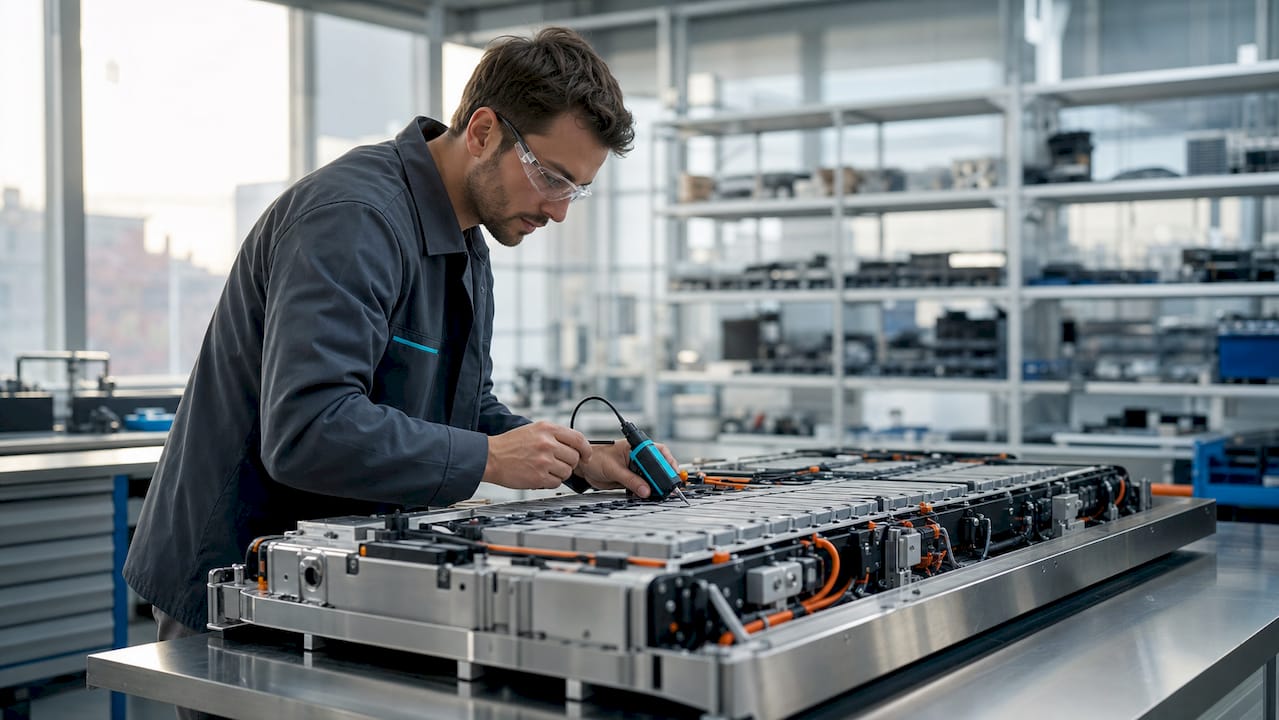
A battery thermal management system (BTMS) is defined as the active or passive control of battery temperature to maintain performance, safety, and longevity across all operating conditions. Thermal management for EV batteries centers on keeping lithium-ion cells within their optimal operating range of 15–35°C while limiting cell-to-cell temperature spread to below 5°C. Exceed 50°C, and thermal runaway becomes a real risk. These three numbers, 15°C, 35°C, and 50°C, define every design decision in automotive thermal management solutions. The industry term for this discipline is battery thermal management, and it spans cooling hardware, refrigerant circuits, control algorithms, and system integration.
What are the main thermal management techniques for EV batteries?
Four primary methods define the current field: air cooling, liquid cold-plate cooling, phase change material (PCM) cooling, and immersion cooling. Each trades off thermal performance, system complexity, and energy consumption differently.
Air cooling uses forced convection to remove heat from battery modules. It is the simplest approach, but it falls short under high discharge rates. At 3C discharge, forced air produces a maximum cell temperature of 44.8°C and a cell-to-cell spread of 8.6°C. Both figures exceed safe operating limits for most lithium-ion chemistries.
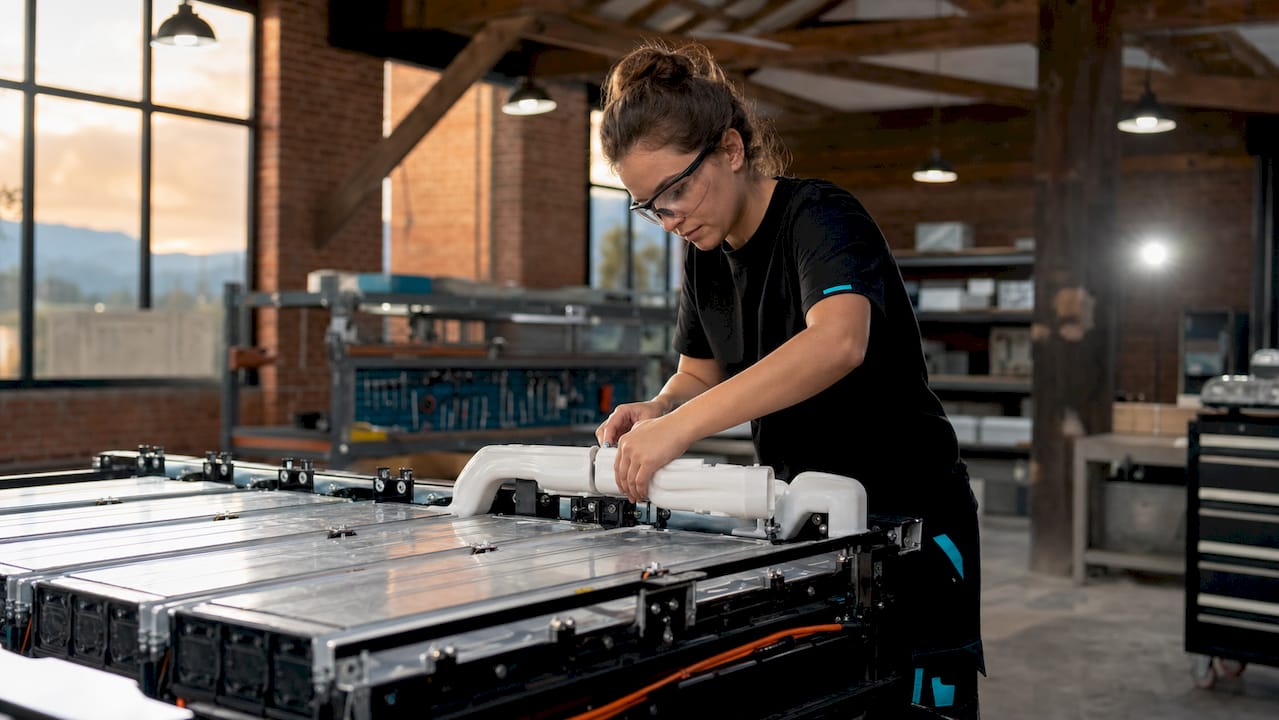
Liquid cold-plate cooling circulates coolant through aluminum plates in contact with battery modules. It delivers far better heat transfer than air but requires careful hydraulic design. Uneven coolant distribution across cold plates creates hotspots that accelerate localized cell degradation. This is the most common method in current production EVs.
Hybrid PCM-liquid cooling combines a phase change material layer with a liquid circuit. At 3C discharge, this approach reduces maximum cell temperature to 33.4°C and cell-to-cell spread to 1.9°C. It also cuts pump power by 38% compared to standalone liquid cooling. That combination of thermal uniformity and reduced parasitic load makes it the strongest performer in the comparison.
Immersion cooling submerges cells directly in dielectric fluid. It provides the highest heat dissipation capacity and the best temperature uniformity, but it introduces material compatibility risks and sealing requirements that add system complexity.
Cooling Method | Max Cell Temp (3C) | Cell-to-Cell Spread | Relative Complexity |
Forced air | 44.8°C | 8.6°C | Low |
Liquid cold plate | ~36°C | ~3°C | Medium |
Hybrid PCM-liquid | 33.4°C | 1.9°C | Medium-high |
Immersion cooling | Lowest | Lowest | High |
Pro Tip: Select hybrid PCM-liquid cooling for high-discharge applications where pump power budget is constrained. Reserve immersion cooling for next-generation high-energy-density packs where the engineering investment in sealing and fluid management is justified.
How are integrated thermal management systems evolving?
Integrated thermal management is the consolidation of battery, powertrain, and cabin HVAC thermal loads into a single refrigerant-based system. This approach replaces multiple independent cooling loops with one shared circuit, reducing weight, component count, and energy consumption simultaneously.
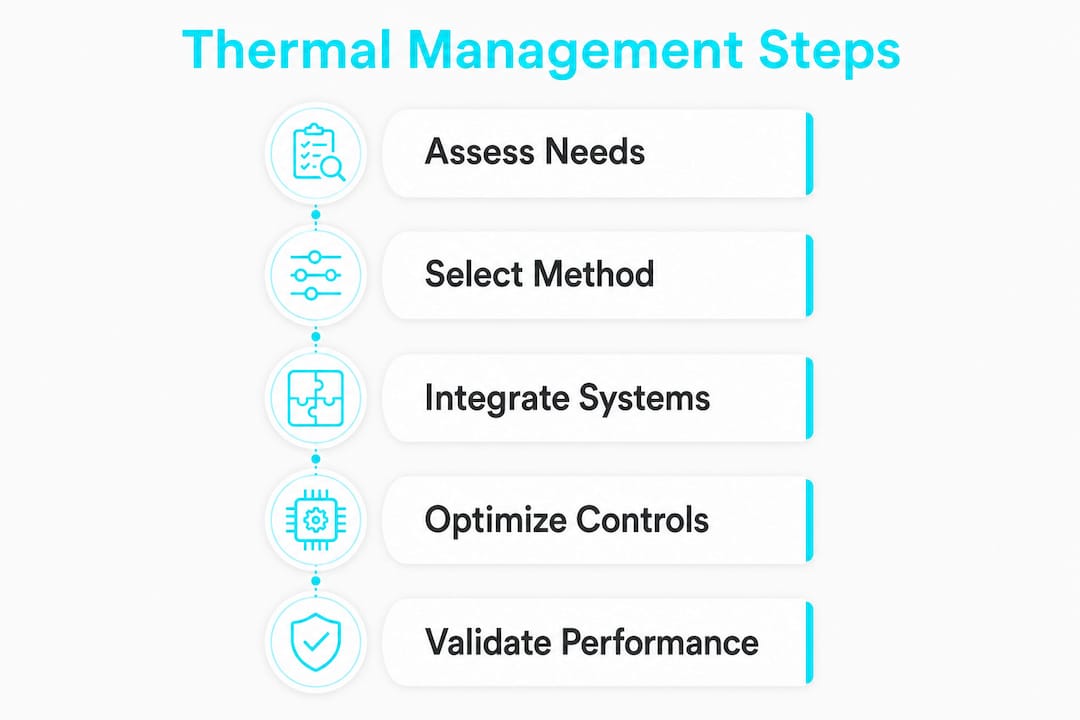
The core architecture uses a refrigerant-based heat pump that manages battery cooling, motor and power electronics cooling, and cabin heating or cooling through a shared loop. Integrated systems use heat recovery from the motor and power electronics to precondition the battery, which reduces the load on resistive heaters during cold starts. That waste heat reuse directly reduces range loss in winter driving conditions.
Key benefits of integrated thermal management include:
Reduced system weight from eliminating redundant pumps, heat exchangers, and coolant lines
Energy recovery by routing motor waste heat to battery preconditioning circuits
Simplified packaging through shared refrigerant loops across multiple thermal loads
Cold-climate performance via air-sourced heat pump operation with low-GWP refrigerants
Refrigerant selection is now a design constraint, not just a performance variable. Low-GWP refrigerants like R290 in transcritical CO2 heat pump configurations maintain strong performance under sub-zero conditions while meeting tightening environmental regulations. Engineers designing systems for global markets must account for regional refrigerant restrictions from the outset.
Waste heat harvesting from the motor and power electronics reduces parasitic heating energy by routing recovered thermal energy directly into battery preconditioning. This integration reduces overall auxiliary power draw and extends effective range. For practical engineering examples of heat exchange architecture in these systems, the heat exchange guide at Jewlztech covers legacy versus modern cooling design approaches in detail.
What control strategies optimize battery thermal management efficiency?
Advanced control is where thermal management systems either recover or waste energy. The Sparrow Search Algorithm coupled with Nonlinear Model Predictive Control (SSA-NMPC) represents the current state of the art in adaptive thermal control for EV battery packs.
The SSA-NMPC framework works by solving a real-time optimization problem that minimizes total thermal management energy consumption while enforcing hard constraints on battery temperature and cabin comfort. During high-speed cruise cycles, this approach reduces energy consumption by 6.31% while holding battery temperature fluctuations to within 0.26°C. That level of thermal stability under dynamic load is difficult to achieve with conventional PID-based controllers.
The framework operates across three coupled loops:
Battery thermal loop: maintains cell temperature within the 15–35°C window under variable discharge rates
Cabin HVAC loop: limits cabin temperature overshoot to 0.35°C during transient conditions
Powertrain loop: coordinates motor and inverter cooling with battery thermal state
Flow uniformity in liquid cold-plate systems remains the hardest constraint to satisfy in practice. Hydraulic pressure drops across parallel channels cause uneven coolant distribution, which creates localized hotspots even when the average module temperature appears acceptable. Control algorithms that ignore hydraulic imbalance will underperform in real hardware.
Pro Tip: Validate your control model against a high-fidelity CFD simulation before hardware testing. Discrepancies between 1D thermal models and real flow behavior are common and expensive to discover late in development. Jewlztech’s CFD simulation tools cover the computational methods relevant to this validation step.
How does immersion cooling perform at vehicle scale?
Vehicle-scale immersion cooling is no longer a laboratory concept. Experimental systems at full pack scale confirm that direct liquid contact with cells delivers superior heat dissipation and temperature uniformity compared to any indirect cooling method. The performance advantage is most pronounced during fast charging and high-rate discharge, exactly the conditions where high-nickel cathode chemistries are most thermally vulnerable.
The engineering challenges at vehicle scale are significant. Immersion cooling systems require dielectric fluids that resist chemical breakdown over the battery pack’s service life. Fluid degradation increases electrical conductivity, which creates leakage current risks. Sealing integrity across hundreds of cell penetrations is a separate and equally demanding problem.
Material compatibility testing must cover the full range of cell housing materials, module structural components, and electrical connectors. Fluids that perform well in short-term tests can cause elastomer swelling or metal corrosion over multi-year service intervals. This is why immersion cooling reliability remains an active research priority even as the thermal performance case is well established.
The practical engineering tradeoffs at vehicle scale break down as follows:
Performance Factor | Immersion Cooling Result |
Heat dissipation capacity | Highest among all methods |
Temperature uniformity | Best cell-to-cell spread |
Dielectric fluid stability | Critical long-term risk |
Sealing complexity | High; requires robust sealing technology |
System weight | Higher due to fluid volume |
Immersion cooling adoption will accelerate as high-energy-density battery packs become standard, but material and system reliability remain the primary barriers to production deployment. Engineers working on next-generation pack designs should treat fluid qualification and sealing validation as parallel workstreams, not afterthoughts.
Key Takeaways
Effective thermal management for EV batteries requires integrating precise temperature control, advanced cooling methods, and adaptive control algorithms to protect cell performance and extend pack life.
Point | Details |
Temperature limits are non-negotiable | Keep cells within 15–35°C and cell-to-cell spread below 5°C to prevent accelerated degradation. |
Hybrid PCM-liquid cooling leads on performance | It achieves 33.4°C max temp and 1.9°C spread at 3C discharge while cutting pump power by 38%. |
Integration reduces energy and complexity | Shared refrigerant loops recover motor waste heat and reduce auxiliary power draw across the full system. |
SSA-NMPC control saves measurable energy | This algorithm cuts thermal management energy use by 6.31% while holding battery fluctuations to 0.26°C. |
Immersion cooling requires sealing and fluid validation | Superior thermal performance is offset by dielectric fluid degradation and sealing risks at vehicle scale. |
What I’ve learned from working at the edge of EV thermal integration
The gap between simulation results and real hardware behavior is wider in thermal management than in almost any other EV subsystem. Models that look clean in 1D thermal analysis often break down the moment you introduce real hydraulic imbalances across a cold plate manifold. I’ve seen well-designed systems underperform simply because the control calibration assumed uniform flow that the hardware never delivered.
The shift toward integrated thermal management is the right direction, but it adds coupling complexity that most development teams underestimate. When your battery loop, motor loop, and cabin HVAC share a refrigerant circuit, a fault or calibration error in one loop propagates to all three. That interdependency demands more rigorous system-level validation than teams accustomed to isolated subsystem testing are used to.
My honest view on immersion cooling is that the thermal case is settled. The fluid qualification and sealing case is not. Researchers who focus on dielectric fluid chemistry and long-term material compatibility will have more practical impact over the next five years than those refining heat transfer coefficients that are already well characterized.
The adoption of low-GWP refrigerants like R290 is coming whether the industry is ready or not. Engineers who build refrigerant flexibility into their system architecture now will avoid expensive redesigns when regional regulations tighten. Dynamic control algorithms like SSA-NMPC are the right tool for managing the added complexity, but they require validated plant models to deliver their promised efficiency gains.
— Joel
Jewlztech’s Thermalysis Toolkit for EV battery thermal design
Engineers working on thermal management system design for EV battery packs need simulation tools that match the complexity of the systems they are building. Jewlztech’s Thermalysis Toolkit is built specifically for this work, covering thermal simulation, CFD analysis, and system-level design for battery pack thermal management.

The toolkit supports the full design workflow, from initial cooling method selection through control strategy validation. It reduces development time by letting you test thermal scenarios computationally before committing to hardware. For engineers researching battery thermal simulation software or working through integrated system design, the Thermalysis Toolkit gives you the modeling depth the problem demands. Visit Jewlztech to access the toolkit and supporting technical resources.
FAQ
What is a battery thermal management system?
A battery thermal management system (BTMS) actively controls battery temperature to keep lithium-ion cells within their safe operating range of 15–35°C. It uses cooling and heating methods to prevent thermal runaway and minimize cell degradation.
What temperature range do EV batteries require?
Lithium-ion EV batteries operate optimally between 15°C and 35°C, with cell-to-cell temperature spread kept below 5°C. Temperatures above 50°C trigger thermal runaway risk.
Which cooling method performs best for EV battery packs?
Hybrid PCM-liquid cooling delivers the best combination of thermal performance and energy efficiency, achieving a 33.4°C maximum cell temperature and 1.9°C spread at 3C discharge while reducing pump power by 38% versus standalone liquid cooling.
How does immersion cooling differ from liquid cold-plate cooling?
Immersion cooling submerges cells directly in dielectric fluid for maximum heat transfer, while liquid cold-plate cooling uses indirect contact through aluminum plates. Immersion cooling performs better thermally but requires dielectric fluid qualification and robust sealing at vehicle scale.
What is SSA-NMPC and why does it matter for thermal control?
SSA-NMPC combines the Sparrow Search Algorithm with Nonlinear Model Predictive Control to minimize thermal management energy consumption in real time. It achieves 6.31% energy savings during high-speed cruise while holding battery temperature fluctuations to within 0.26°C.
Comments