
Heat Transfer Techniques: A Practical Engineering Guide

Heat transfer techniques are classified into four primary engineering mechanisms: conduction, convection, radiation, and phase change. Each moves thermal energy through a distinct physical process, and each demands a different design approach. Engineers who treat these methods as interchangeable make costly errors in thermal system design. This guide breaks down all four mechanisms, explains the physics behind each, and gives you a clear framework for selecting and combining them in real applications.
1. What are the core heat transfer techniques in engineering?
The four primary mechanisms for moving thermal energy are conduction, convection, radiation, and phase change. Conduction and convection require a material medium. Radiation does not. Phase change typically requires a medium but operates on a fundamentally different energy principle than the other three. Knowing which mechanism dominates in your system is the first step toward accurate thermal analysis.
These mechanisms rarely act alone. Combined effects of conduction, convection, and radiation coexist in nearly every practical thermal engineering scenario. Ignoring their interaction produces significant simulation errors. The sections below treat each method individually, then address how to select and combine them.
2. What is conduction and where is it applied?
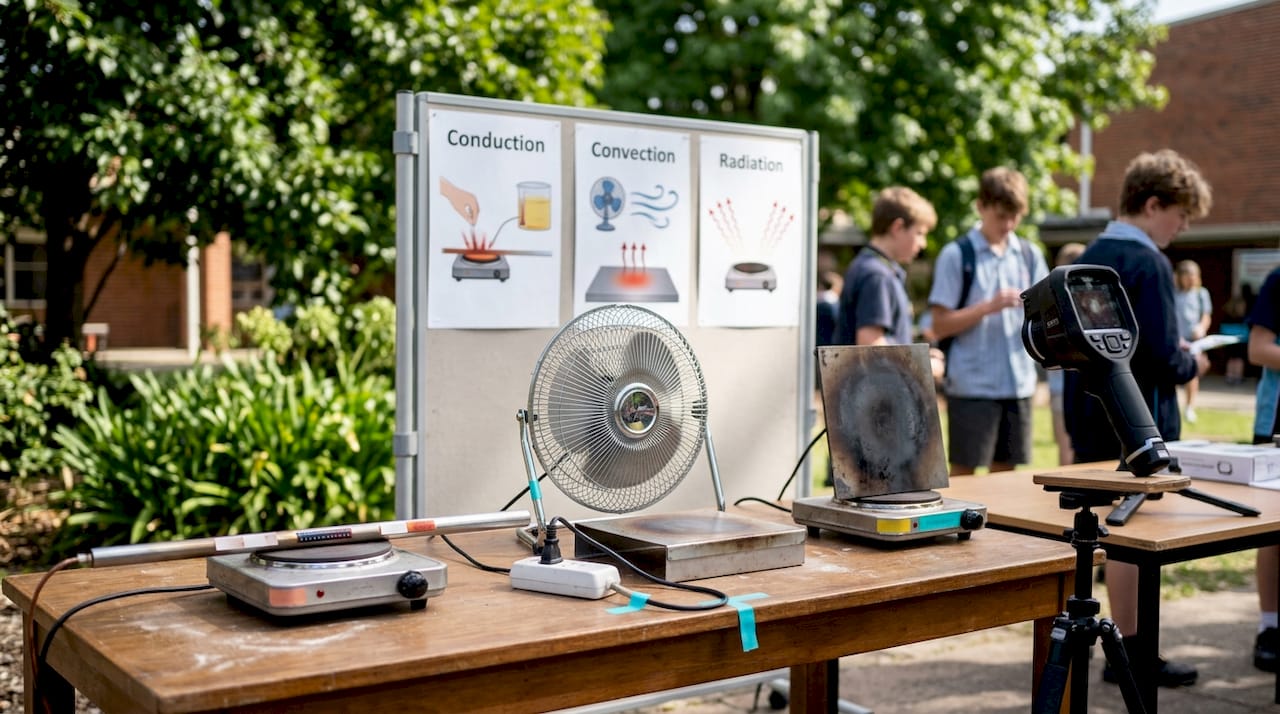
Conduction transfers heat through direct molecular interaction within a solid or stationary fluid. Atoms and electrons in a high-temperature region vibrate and collide with neighboring particles, passing kinetic energy along the material. No bulk movement of matter occurs. The rate of heat flow depends entirely on the material’s thermal conductivity and the temperature gradient across it.
Thermal conductivity varies with both material type and operating temperature. This means engineers cannot use a single conductivity value across a wide temperature range without introducing error. For accurate heat flow calculations, temperature-dependent conductivity data is required.
Common conduction applications in engineering include:
Heat flow through metal walls in pressure vessels and heat exchangers
Thermal insulation design for pipelines and furnace linings
Semiconductor and PCB thermal management
Structural components exposed to high-temperature gradients
Pro Tip: Select materials based on whether you need to conduct or resist heat flow. Copper conducts roughly 700 times more heat than fiberglass insulation. Choosing the wrong material class at the design stage is one of the most common and expensive thermal engineering mistakes.
3. How does convection work, and what distinguishes natural from forced convection?
Convection transfers heat through the bulk motion of a fluid combined with molecular diffusion. Warmer fluid carries thermal energy away from a surface as it moves, replacing it with cooler fluid. The result is a continuous heat exchange between the solid surface and the surrounding fluid.
Two distinct types define convective heat transfer in engineering:
Natural convection: Buoyancy drives fluid motion. Warmer, less dense fluid rises while cooler fluid sinks, creating circulation without mechanical input. This occurs in passive cooling systems and building HVAC design.
Forced convection: Mechanical means such as pumps or fans increase fluid velocity, significantly enhancing heat transfer efficiency. Industrial cooling systems, shell-and-tube heat exchangers, and liquid-cooled electronics all rely on forced convection.
The boundary layer between a solid surface and the moving fluid is critical. Near solid surfaces, fluid velocity approaches zero, so conduction dominates heat transfer in that thin layer. Farther from the surface, bulk fluid motion takes over and convection predominates. Accurate thermal simulation requires modeling this transition correctly.
Pro Tip: Increasing surface area with fins or turbulators directly increases the convective heat transfer rate. In heat exchanger design, surface geometry changes often deliver more efficiency gain than switching to a higher-conductivity material.
For a deeper look at how convection and conduction interact in real systems, the heat exchange examples guide from Jewlztech covers practical design scenarios in detail.
4. What is thermal radiation and how does it differ from the other methods?
Thermal radiation transfers energy via infrared electromagnetic waves. No material medium is required. A hot surface radiates energy across a vacuum just as effectively as across air, which makes radiation the dominant heat transfer mechanism in space applications and high-temperature furnace design.
The governing physics come from the Stefan-Boltzmann law, which states that radiated power scales with the fourth power of absolute temperature. Radiation operates via electromagnetic waves, primarily infrared, and its intensity is also controlled by emissivity, a surface property ranging from 0 to 1. A blackbody with emissivity of 1 radiates at maximum efficiency. Polished metals with low emissivity radiate far less.
Key radiation applications include:
Radiative cooling panels in spacecraft thermal control
Solar panel energy absorption and thermal load analysis
Furnace and combustion chamber design
Infrared heating systems in industrial drying processes
The fourth-power temperature dependence means radiation becomes increasingly significant at high temperatures. Below 300°C, radiation is often a secondary effect. Above 800°C, it frequently dominates over both conduction and convection.
5. How does phase change heat transfer work?
Phase change heat transfer moves energy when a material changes state: solid to liquid, liquid to vapor, or the reverse. The energy involved is latent heat, absorbed or released at a constant temperature without changing the material’s temperature during the transition. This property makes phase change one of the most efficient thermal management mechanisms available to engineers.
Evaporation is a critical cooling mechanism because molecules transitioning to the gas phase carry large amounts of thermal energy away from the surface. This principle underlies evaporative cooling towers, refrigeration cycles, and heat pipes. The same latent heat concept applies in reverse during condensation, where vapor releases heat as it returns to liquid.
Phase change applications in engineering include:
Refrigeration and vapor-compression cooling cycles
Steam-based industrial heating systems
Heat pipes for electronics thermal management
Evaporative cooling in power plant condensers
Pro Tip: In heat pipe design, the working fluid selection determines the effective temperature range. Water works well between 30°C and 200°C. For cryogenic applications, nitrogen or helium is required. Matching the fluid to the operating temperature range is non-negotiable for reliable performance.
Phase change rarely operates in isolation. In a steam heating system, for example, conduction moves heat through the pipe wall, convection distributes it through the fluid, and condensation delivers the latent heat payload to the process. All four mechanisms contribute.
6. How to compare and select the right heat transfer method
Selecting the right thermal management approach requires evaluating four factors: the medium available, the operating temperature range, the required heat flux, and the system complexity you can tolerate. No single method is universally superior.
Mechanism | Medium required | Best temperature range | Typical applications | Key limitation |
Conduction | Solid or stationary fluid | Any | Walls, insulation, electronics | Requires physical contact |
Natural convection | Fluid | Low to moderate | Passive cooling, HVAC | Low heat transfer rate |
Forced convection | Fluid | Low to high | Heat exchangers, cooling systems | Requires mechanical input |
Radiation | None | High (above 300°C) | Furnaces, space systems | Negligible at low temperatures |
Phase change | Fluid or two-phase | Application-specific | Refrigeration, heat pipes | Complex system design |
Overall heat transfer coefficients used in heat exchanger design already account for combined conduction, convection, and radiation effects. Engineers use these combined values because isolating each individual parameter in a real system is rarely practical. This approach reflects how thermal systems actually behave.
One frequently overlooked factor is the role of air in fluid systems. Air offers roughly 30 times greater resistance to heat flow than water. In steam-based heat exchangers, trapped air dramatically reduces efficiency. Proper venting and air removal are as important as material selection.
For complex systems, combining mechanisms delivers the best results. A well-designed industrial heat exchanger uses forced convection on both sides of the wall, conduction through the wall itself, and phase change on the process side. Treating these as separate problems rather than an integrated system leads to underperforming designs.
Key takeaways
The most effective thermal system designs combine conduction, convection, radiation, and phase change rather than relying on a single mechanism in isolation.
Point | Details |
Four core mechanisms | Conduction, convection, radiation, and phase change each move heat through distinct physical processes. |
Medium dependency matters | Conduction and convection need a medium; radiation works in a vacuum and dominates above 800°C. |
Boundary layer behavior | Conduction dominates near solid surfaces; convection takes over as fluid velocity increases with distance. |
Phase change efficiency | Latent heat transfer moves large amounts of energy at constant temperature, making it ideal for cooling cycles. |
Combined effects are the norm | Real systems involve all mechanisms simultaneously; using overall heat transfer coefficients accounts for this. |
Why engineers underestimate combined heat transfer effects
The biggest mistake I see in thermal system design is treating each heat transfer mechanism as a separate calculation. Engineers run a conduction analysis, then a convection analysis, then add them up. That approach misses the interaction between mechanisms and produces designs that fail in the field.
Real systems are messier than textbook problems. Fouling on heat exchanger surfaces changes the effective conductivity over time. Material properties shift with temperature, so the conductivity value you used at startup is not the same value at operating temperature. Radiation becomes significant at temperatures that engineers often dismiss as “too low to matter,” then find it contributes 15–20% of total heat transfer in their furnace wall.
My recommendation is to build simulation models that account for all active mechanisms from the start. Jewlztech’s thermal simulation tools are built specifically for this kind of combined-mechanism analysis. Staying current with material science data is equally important. A conductivity value from a 1990s datasheet may not reflect the actual material you are purchasing today.
The engineers who get thermal design right are the ones who treat it as a system problem, not a mechanism-by-mechanism checklist.
— Joel
Jewlztech’s tools for heat transfer analysis
Thermal system design requires software that handles all four mechanisms simultaneously, not just one at a time.

Jewlztech’s Thermalysis Toolkit is built for exactly this kind of analysis. It covers conduction, convection, radiation, and phase change simulations within a single environment. The toolkit includes a material property database with temperature-dependent conductivity values, so your calculations reflect real operating conditions rather than idealized assumptions. Engineers and researchers working on heat exchangers, pressure vessels, or electronics cooling can run combined-mechanism models without switching between separate tools. Students can access it as part of Jewlztech’s free engineering software offerings. For a broader look at available tools, the engineering software guide covers what is available in 2026.
FAQ
What are the four main heat transfer techniques?
The four primary mechanisms are conduction, convection, radiation, and phase change. Conduction and convection require a material medium, radiation does not, and phase change relies on latent heat during state transitions.
How does forced convection differ from natural convection?
Forced convection uses mechanical devices such as pumps or fans to increase fluid velocity and heat transfer rate. Natural convection relies on buoyancy-driven fluid motion without any mechanical input.
Why does radiation dominate at high temperatures?
Radiated power scales with the fourth power of absolute temperature under the Stefan-Boltzmann law. This means radiation increases far faster than conduction or convection as temperature rises, making it the dominant mechanism above roughly 800°C.
What is latent heat and why does it matter in engineering?
Latent heat is the energy absorbed or released during a phase change at constant temperature. It allows phase change systems like refrigeration cycles and heat pipes to move large amounts of thermal energy with minimal temperature difference.
Can multiple heat transfer mechanisms act at the same time?
Yes. In most real engineering systems, conduction, convection, and radiation occur simultaneously. Heat exchanger design uses overall heat transfer coefficients that account for all active mechanisms together rather than treating each one separately.
Recommended
Comments