
Active Cooling vs Passive Cooling: Engineer's Decision Guide

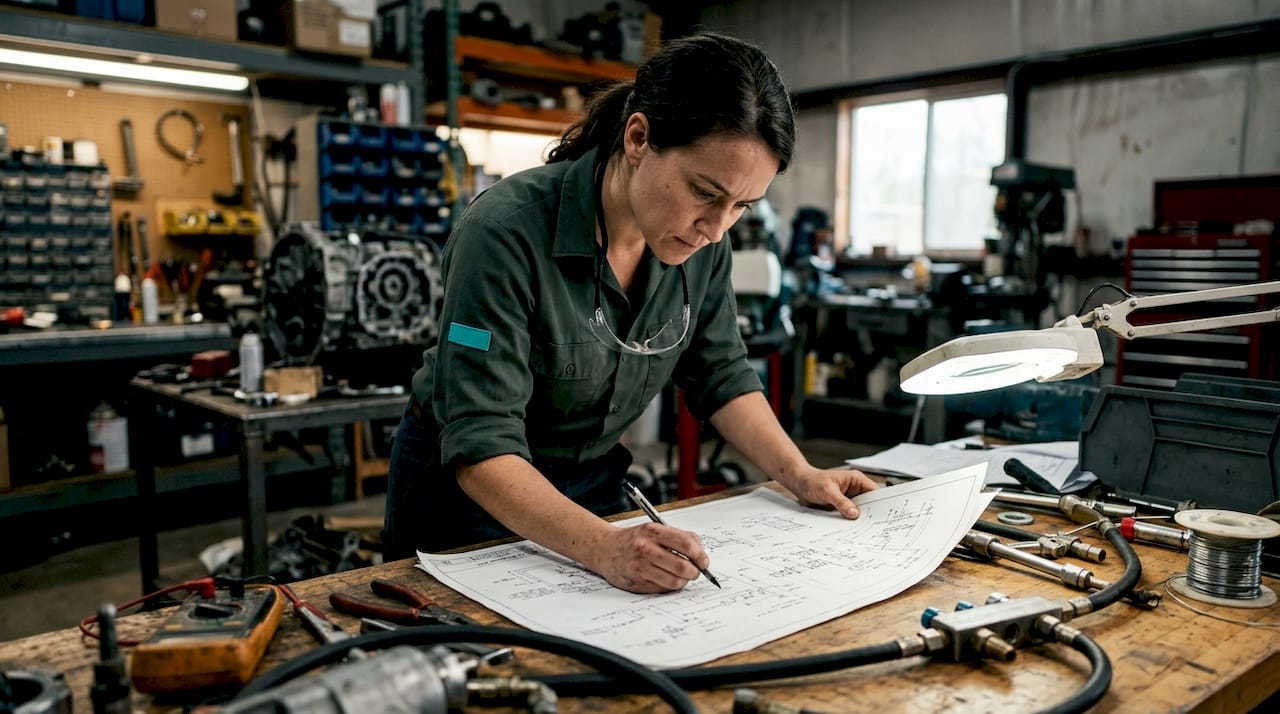
Active cooling is defined as any thermal management method that uses powered components, such as fans, pumps, or Peltier devices, to move heat away from a source. Passive cooling relies entirely on natural heat transfer mechanisms, including conduction, natural convection, and radiation, with no external power input. The choice between active cooling vs passive cooling is not simply about heat load. It depends on reliability requirements, acoustic constraints, service life, and enclosure design. Engineers who treat this as a binary choice often over-engineer their systems. The most effective thermal architectures start with a passive baseline and add active methods only when constraints demand it.
1. What are active cooling methods?
Active cooling uses input electrical power to force heat transfer at rates that natural convection cannot achieve. The three main categories are forced-air systems, liquid cooling systems, and thermoelectric or refrigeration devices.
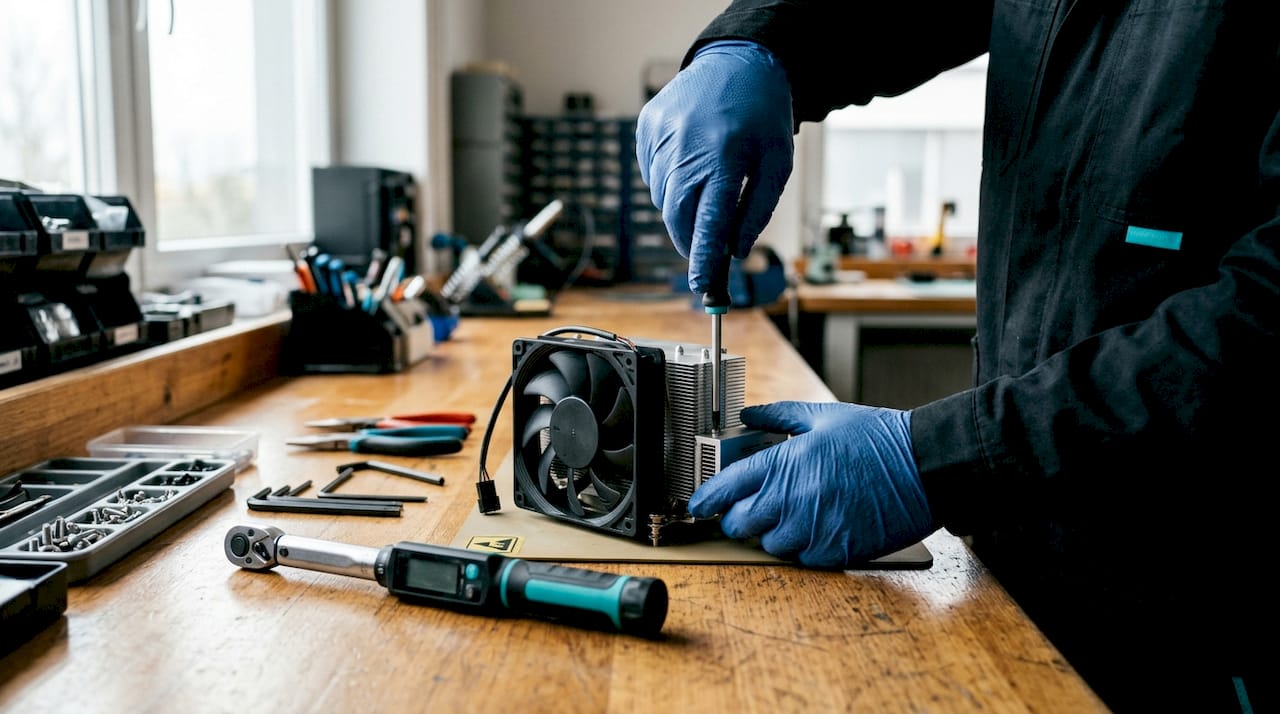
Forced-air cooling uses fans or blowers to push air across heat sinks or through enclosures. This is the most common active method in electronics and industrial controls. Fan-cooled systems are low cost and easy to implement, but fan motors carry the shortest mean time between failure of any component in a cooling assembly. That single fact makes forced air a liability in long-life or maintenance-restricted deployments.
Liquid cooling uses pumps, cold plates, and fluid loops to carry heat from a source to a remote radiator or heat exchanger. Liquid systems handle much higher heat flux densities than air and are standard in high-performance computing and automotive battery thermal management. The tradeoff is system complexity: pumps, fittings, and fluid reservoirs all add failure points.
Thermoelectric coolers (Peltier devices) and vapor-compression refrigeration systems achieve sub-ambient cooling. They are used in laser diode temperature stabilization, medical instruments, and precision laboratory equipment. Active systems enable sub-ambient cooling and high heat loads in small volumes, but at the cost of significant power draw and added maintenance.
Forced-air: low cost, widely available, limited by acoustic noise and fan life
Liquid cooling: high heat flux capacity, complex plumbing, pump maintenance required
Peltier devices: sub-ambient capability, low efficiency, best for precision temperature control
Vapor-compression refrigeration: highest cooling power, largest footprint, highest energy use
Pro Tip: When specifying fans for forced-air systems, always request fan telemetry (tachometer or PWM feedback) and design for fan-out failure mode. A single fan failure in an unmonitored system can cause thermal shutdown within minutes.
2. What are passive cooling techniques and their advantages?
Passive cooling is thermal management without moving parts or external power. It relies on three physical mechanisms: conduction through solid materials, natural convection of surrounding air or fluid, and thermal radiation to the environment.
Basic passive methods include aluminum or copper heat sinks with extended fin arrays, thermal interface materials, and chassis-level conduction paths. These work well for heat loads up to roughly 1–2 W per square centimeter under natural convection, depending on fin geometry and ambient conditions.
Advanced two-phase passive devices are where passive cooling becomes genuinely competitive with active systems. Heat pipes, vapor chambers, and thermosyphons use the latent heat of vaporization to transport large amounts of thermal energy with minimal temperature drop. Passive technologies achieve effective thermal conductivities of 1,500–50,000 W/m·K. That range is orders of magnitude above copper at 400 W/m·K, achieved with no power consumption whatsoever.
Passive two-phase cooling devices provide decades of reliable operation without scheduled maintenance. In sealed enclosures where fan replacement is impossible, heat pipes and vapor chambers are often the only viable path to long-term thermal compliance.
The reliability advantage is concrete. Passive cooling eliminates all fan-related failure modes. One documented embedded board design with approximately 1.15W of dissipation ran comfortably at 55°C ambient using purely passive methods. That result would require a fan in a less optimized thermal stack.
No energy consumption: zero operating cost after installation
Zero moving parts: no wear, no scheduled replacement, no acoustic noise
Decades of service life: heat pipes and vapor chambers require no maintenance
Sealed enclosure compatibility: works where fans cannot be serviced or installed
Pro Tip: Before adding a fan to any design, model or measure the passive thermal path first. A well-designed heat pipe assembly often eliminates the need for forced air entirely, saving power and improving reliability.
3. How to decide between active and passive thermal management
The decision between active vs passive thermal management requires evaluating at least six independent constraints. Heat load is only one of them.
1. Heat load and thermal budget. Calculate the total power dissipation and the allowable junction-to-ambient thermal resistance. If passive methods can meet the thermal budget with margin, active cooling adds unnecessary complexity.
2. Service life and maintenance access. A 200W load in a sealed enclosure with a 15-year service life and no maintenance access rules out most active options. Passive two-phase devices are the correct answer in that scenario.
3. Acoustic noise constraints. Medical devices, office equipment, and residential electronics often have strict noise limits. Fans generate broadband noise that is difficult to eliminate. Passive systems are inherently silent.
4. Vibration and shock environment. Military, aerospace, and transportation applications expose cooling systems to vibration and shock. Fans and pumps are vulnerable. Heat pipes and vapor chambers tolerate these environments without degradation.
5. Power availability. Battery-powered and energy-harvesting systems cannot afford the parasitic draw of fans or pumps. Passive cooling in embedded and mobile devices is the standard precisely because power budgets are tight.
6. Ambient conditions and temperature thresholds. If the ambient temperature approaches or exceeds the required component temperature, passive cooling cannot work. Sub-ambient cooling requires active refrigeration. This is a hard physical limit, not a design preference.
Constraint | Favors passive | Favors active |
Heat load | Low to moderate | High density |
Service life | Long, maintenance-free | Short or serviceable |
Acoustic noise | Strict limits | Tolerant environment |
Power budget | Constrained | Available |
Enclosure | Sealed | Ventilated |
Ambient temperature | Well below component limit | Near component limit |
Pro Tip: Treat passive cooling as your baseline and active cooling as a supplement. Active and passive methods work best as a spectrum: optimize the passive stack first, then add a fan or pump only for peak loads or tight thermal budgets.
4. Practical examples and use cases
Real engineering decisions become clearer with concrete examples across different industries.
Embedded and sealed electronics. Low-power industrial controllers, IoT gateways, and ruggedized field instruments routinely use passive cooling. A well-designed aluminum enclosure with internal heat spreaders and an external fin array can handle 10–30W without a fan. This approach is standard in oil and gas instrumentation where maintenance access is limited and contamination ingress from fan openings is unacceptable.
High-performance computing and data centers. Server CPUs and GPUs dissipate hundreds of watts per chip. Active cooling dominates in data centers, where liquid cooling loops and forced-air server racks are the norm. Direct liquid cooling to the chip using cold plates is increasingly common as heat flux densities rise above what air can manage.
Automotive battery thermal management. Electric vehicle battery packs use hybrid approaches. Passive thermal interface materials and aluminum cooling plates spread heat across cells. Active liquid cooling loops then carry that heat to a front-mounted radiator or chiller. Neither method alone is sufficient. The passive layer manages cell-to-cell uniformity; the active loop manages total pack temperature.
Building thermal management. Passive cooling in buildings uses natural ventilation, thermal mass, and solar shading. Research shows neutral temperature ranges from 19.5°C to 36.3°C across climate classes, which means occupants in hot-humid climates tolerate a wide band of conditions. That tolerance makes passive building strategies viable across a much larger portion of the year than engineers typically assume.
Hybrid systems. Modern thermal architectures combine passive heat spreaders with active fans or liquid cooling for peak loads and transient conditions. A vapor chamber spreads heat from a high-flux chip to a larger surface area. A fan then cools that surface during peak operation. At idle, the fan stops and the vapor chamber handles the load passively. This approach cuts average power consumption and extends fan life significantly.
Application | Primary method | Supplemental method |
Sealed industrial controller | Passive (heat sink, conduction) | None |
Server CPU | Active (liquid cold plate) | Passive spreader |
EV battery pack | Passive (thermal interface) | Active (liquid loop) |
Embedded IoT gateway | Passive (natural convection) | None |
High-power RF amplifier | Active (forced air) | Passive heat pipe |
Key Takeaways
Passive cooling is the correct baseline for most engineering designs. Active methods should be added only when passive solutions cannot meet the thermal budget or ambient conditions make natural heat transfer insufficient.
Point | Details |
Start with passive | Optimize the passive thermal path before specifying any active component. |
Constraints drive the choice | Service life, noise, and enclosure type matter as much as heat load. |
Two-phase devices are powerful | Heat pipes and vapor chambers reach 50,000 W/m·K with zero power draw. |
Active adds failure points | Fans carry the shortest MTBF in any cooling assembly. |
Hybrid systems work best | Combine passive baselines with active peak control for efficiency and reliability. |
Joel’s take on getting thermal design right
Most engineers I work with reach for a fan too quickly. The instinct makes sense: fans are cheap, easy to specify, and immediately effective. The problem shows up two years into a product’s life when the fan bearing fails in a sealed cabinet in a remote location, and the whole system goes down.
The thermal management teams that get this right start every design with a constraint audit, not a heat load calculation. They ask: Can this enclosure ever be opened for maintenance? Is there a noise limit? What is the service life target? Those answers almost always point toward passive cooling as the primary solution, with active methods held in reserve.
Active and passive cooling are not competing philosophies. They are tools with different cost profiles. Passive costs nothing to run and almost nothing to maintain. Active costs power every hour it operates and requires a replacement plan. When you frame it that way, the default shifts toward passive, and active becomes a deliberate engineering choice with a justified cost.
The other mistake I see regularly is treating simulation as optional. Running a CFD or thermal simulation before committing to a cooling architecture catches problems that no amount of intuition will find. It also gives you the data to defend your design in a design review. That step is not a luxury for complex systems. It is the minimum standard for responsible thermal engineering.
— Joel
Thermal design tools from Jewlztech
Engineers who want to validate their cooling architecture before committing to hardware need simulation tools that match the complexity of the problem.

Jewlztech builds the Thermalysis Toolkit for exactly this purpose. The toolkit supports thermal simulation, CFD analysis, and pressure vessel evaluation in a single platform, giving engineers the data they need to choose between passive and active approaches with confidence. Whether you are sizing a heat pipe assembly for a sealed enclosure or modeling airflow through a forced-air server rack, the Thermalysis Toolkit gives you quantitative answers before the first prototype is built. Visit the Thermalysis Toolkit page to see what the platform covers and how it fits your design workflow.
FAQ
What is the main difference between active and passive cooling?
Active cooling uses powered components like fans, pumps, or Peltier devices to move heat. Passive cooling uses only natural heat transfer mechanisms, such as conduction and convection, with no energy input.
When should an engineer choose passive over active cooling?
Passive cooling is the right choice when the enclosure is sealed, the service life is long, acoustic noise is restricted, or the power budget is constrained. Passive two-phase devices like heat pipes handle these conditions reliably for decades.
How effective are heat pipes compared to metal heat sinks?
Heat pipes and vapor chambers achieve effective thermal conductivities of 1,500–50,000 W/m·K, compared to roughly 400 W/m·K for copper. That performance gap makes two-phase passive devices the correct choice for high-flux, low-power applications.
Can active and passive cooling be combined?
Yes. Hybrid systems use a passive layer, such as a vapor chamber or thermal interface material, to spread heat, then add a fan or liquid loop for peak load conditions. This combined approach reduces average power consumption and extends the life of active components.
What is the biggest reliability risk in active cooling systems?
Fan motors carry the shortest mean time between failure of any component in a forced-air cooling assembly. Eliminating fans through passive design or reducing fan duty cycle through hybrid approaches directly improves system reliability.
Recommended
Comments