
Nusselt Number Meaning for Engineers: Practical Worked Example

Updated: 1 day ago
The Nusselt number tells you how much better convection moves heat than plain conduction would through the same fluid layer. It’s defined as Nu = hL/k, where h is the convective heat transfer coefficient, L is a characteristic length, and k is the fluid’s thermal conductivity. A Nusselt number of 1 means heat crosses that layer by conduction alone. Values above 1 indicate the presence and effect of convection in heat transfer, and engineers use this parameter to size heat exchangers, cooling systems, and pipe flows.
TL;DR:
Applying a Nusselt number correlation outside its validated Re and Pr range can lead to significantly inaccurate heat transfer estimates.
Selecting the correct characteristic length, such as hydraulic diameter versus pipe diameter, is essential to avoid large errors in calculated Nu values.
Using fluid properties at the film temperature rather than bulk temperature improves the accuracy of convection calculations, especially with large temperature differences.
Empirical correlations like Dittus–Boelter and Gnielinski provide practical Nu estimates for turbulent internal and external flows within specific flow regimes.
For complex geometries or flows near the correlation boundaries, CFD simulations or specialized analytical tools offer more reliable results than simple empirical formulas.
Table of Contents
What the Nusselt Number Definition Actually Says
The Nusselt number is a dimensionless group, meaning it carries no units of its own even though every variable inside it does. The full formula is:
Nu = hL/k
Here, h is the convective heat transfer coefficient in watts per square meter per Kelvin (W/m²·K), the quantity you’re usually trying to solve for in a real design problem. L is a characteristic length in meters, chosen based on the geometry of the flow. k is the thermal conductivity of the fluid in watts per meter per Kelvin (W/m·K), evaluated at a specific reference temperature.
Engineers work with two versions of this number depending on what question they’re asking. The local Nusselt number, written Nu_x, describes convective behavior at one specific point along a surface, useful when you need to know where a heat exchanger tube is hottest or where a boundary layer is thinnest. The average Nusselt number, Nu_L, integrates that local value over an entire surface or flow length, and it’s what you use when sizing equipment rather than diagnosing a hot spot.
$$Nu_L = \frac{1}{L}\int_0^L Nu_x , dx$$
There’s a second way to think about Nu that clarifies why it works as a ratio in the first place. At the fluid-solid interface, heat transfer is technically all conduction, since fluid velocity at a solid wall is zero (the no-slip condition). The Nusselt number can be rewritten as a nondimensional temperature gradient evaluated right at that surface:
$$Nu = \left.\frac{\partial \theta}{\partial \eta}\right|_{\eta=0}$$
where θ is a normalized temperature and η is a normalized distance from the wall. A steep gradient at the wall means the fluid is efficiently sweeping heat away as soon as it leaves the surface, which is exactly what a high Nusselt number is telling you.
Why the Nusselt Number Matters Physically
A Nusselt number of 1 means the fluid right against the wall behaves as if it were frozen solid, transferring heat by conduction only, with no bulk motion helping things along. That’s the baseline. Every value above 1 quantifies how much convection amplifies that baseline rate, and in turbulent flow, Nu commonly lands in the 100 to 1,000 range, meaning convection can move heat two to three orders of magnitude faster than conduction alone would manage.
The physical story behind that number is the thermal boundary layer. Near any heated or cooled surface, fluid temperature transitions gradually from the wall temperature to the bulk fluid temperature over some finite thickness. A thick boundary layer insulates the surface the way a thick blanket insulates skin. A thin one lets heat escape fast. Nusselt number and boundary layer thickness move in opposite directions: raise the Nusselt number and you’re describing a thinner thermal boundary layer, more vigorous mixing near the wall, and a steeper temperature gradient right at the surface.
There’s a useful analogy here to the friction coefficient in fluid mechanics. Just as the friction factor nondimensionalizes wall shear stress to describe momentum transfer, Nusselt number nondimensionalizes wall heat flux to describe energy transfer. Both numbers describe what’s happening in the same thin region near a wall, one for momentum, one for heat, and in many flows they’re linked through the Reynolds analogy. Some researchers argue Nu conflates two separate things, the sheer quantity of heat moved and a more subtle quality measure tied to entropy generation, and have proposed splitting Nusselt number into separate nondimensional groups for cases where that distinction actually changes a design decision. For most day-to-day engineering work, though, treating Nu as convective enhancement over conduction is the right mental model.
None of this happens randomly. The rate at which convection outpaces conduction depends heavily on how fast the fluid moves and how it behaves thermally, which is exactly what the next set of numbers captures.
How Nu Connects to Reynolds, Prandtl, and Rayleigh Numbers
The Nusselt number is never calculated from a formula in isolation. It’s almost always the output of a correlation built from other dimensionless groups, because those groups capture the physics driving convection in the first place.
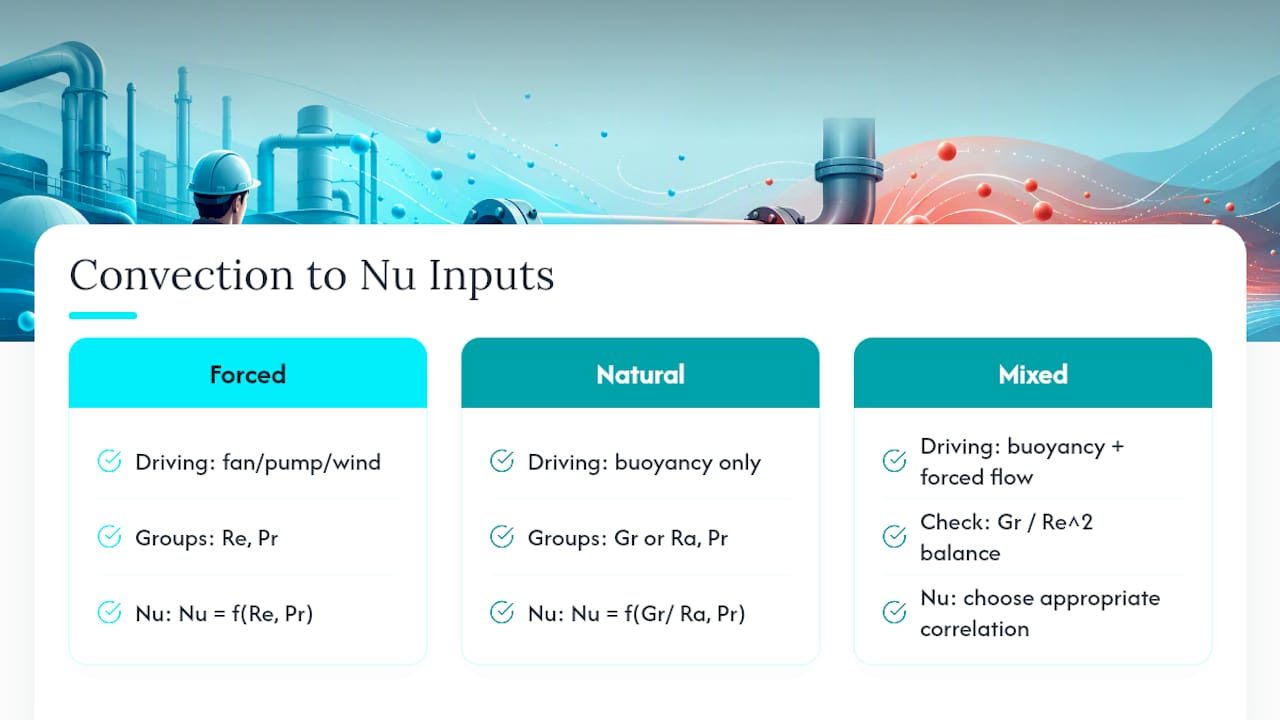
For forced convection, where an external force (a pump, a fan, wind) pushes the fluid past the surface, Nu is expressed as a function of Reynolds number and Prandtl number: Nu = f(Re, Pr). Reynolds number (Re = AVL/μ) measures the ratio of inertial to viscous forces and tells you whether flow is laminar or turbulent. Prandtl number (Pr = can/k) compares how quickly momentum diffuses through a fluid versus how quickly heat does, and it’s purely a fluid property, unaffected by flow conditions.
For natural (free) convection, where buoyancy alone drives fluid motion because of density differences from heating, Nu depends on Grashof number or Rayleigh number combined with Prandtl number: Nu = f(Gr, Pr) or Nu = f(Ra, Pr). Grashof number compares buoyant force to viscous force. Rayleigh number, the product of Grashof and Prandtl, indicates whether buoyant flow will be smooth or will transition into turbulent convection cells.
Which group dominates depends entirely on what’s moving the fluid. A fan-cooled electronics enclosure lives in Re and Pr territory. A vertical wall radiating heat into still room air lives in Ra and Pr territory. Get the regime wrong and you’ll reach for the wrong correlation entirely, which is one of the most common calculation errors in practice.
Picking the Right Characteristic Length for Your Geometry
The characteristic length L inside Nu = hL/k isn’t a fixed physical constant. It’s a modeling choice, and picking the wrong one is one of the most common sources of error in convection calculations.
For internal flow in a circular pipe, L is the pipe’s inner diameter. For flow through a non-circular duct, engineers switch to the hydraulic diameter, D_h = 4A/P, where A is cross-sectional flow area and P is the wetted perimeter. Confusing these two is a real problem: using a pipe’s actual diameter where a hydraulic diameter is called for (say, in a rectangular duct or an annular gap) throws off both the Reynolds number and the resulting Nusselt number, sometimes by a wide margin.
For flow over a flat plate, L is typically the plate length measured in the flow direction. For flow across a cylinder or sphere, L is the diameter perpendicular to flow. For a vertical heated wall in natural convection, L is usually the wall’s height.
The local versus average distinction matters just as much as the length choice itself. Nu_x describes convective intensity at one cross-section or one point on a surface; entrance regions of pipes, for instance, show a much higher local Nu than the fully developed region further downstream. Nu_L (or Nu_D for pipes) averages that behavior over the whole length, which is the number you actually plug into a design calculation to size a heat exchanger or estimate total heat duty.
Pro Tip: Whenever you read a correlation from a textbook or paper, check whether it reports Nu_x or Nu_L before you use it. Mixing a local correlation into an average-Nu calculation is a quiet way to get a plausible-looking but wrong answer.
Nusselt Number Correlations Engineers Actually Use
Very few real Nusselt numbers get calculated from first principles. Almost all engineering work leans on empirical correlations built from decades of experimental data, each one valid only inside the Reynolds and Prandtl range it was fitted to.
Dittus–Boelter equation: Nu = 0.023 Re^0.8 Pr^n (n = 0.4 for heating, 0.3 for cooling). Valid for turbulent flow in smooth tubes, roughly Re > 10,000 and 0.6 ≤ Pr ≤ 160. It’s the workhorse correlation for turbulent internal pipe flow and the one most students meet first.
Sieder–Tate equation: A variant of Dittus–Boelter that adds a viscosity correction term for fluids with strong property variation between wall and bulk temperature, useful for viscous oils and similar fluids.
Gnielinski correlation: A more accurate, more complex relation covering a wider range, roughly 3,000 < Re < 5,000,000 and 0.5 < Pr < 2,000, including the transitional regime that Dittus–Boelter handles poorly.
Constant-property laminar pipe flow: For fully developed laminar flow with constant wall heat flux, classical theory gives a fixed value, Nu = 4.36, independent of Reynolds or Prandtl number entirely. Recent reviews confirm this holds under classic assumptions but show real departures once buoyancy or higher flow rates enter the picture.
External flow correlations: Flat plates, cylinders in cross-flow, and spheres each have their own fitted relations, typically written as Nu = C·Re^m·Pr^n with constants C, m, n depending on geometry and flow regime.
What do the resulting numbers actually mean once you’ve calculated one? A Nusselt number near 1 signals conduction-dominated heat transfer, common in stagnant fluids, gases in narrow gaps, or very slow creeping flows. Values in the 10 to 100 range are typical of moderate laminar or transitional convection, the kind you’d see in laminar pipe flow or gentle natural convection off a warm wall. Values above 100, and especially in the 100 to 1,000 range typical of turbulent flow, indicate strong convective mixing where the fluid is aggressively carrying heat away from the surface. Some high-velocity turbulent industrial flows push well past 1,000.
One nuance worth flagging: correlations built for smooth round tubes with simple fluids don’t automatically transfer to different geometries or modified fluids. Tube shape, packing density, flow blockage, and additives like nanofluids all shift the resulting Nu in ways a generic correlation won’t capture. If you’re built a system that looks meaningfully different from the correlation’s original test setup, treat the result as a first estimate, not a final answer.

Forced Convection, Natural Convection, and When They Mix
Forced convection happens when an external mechanism, a pump, a fan, a compressor, moves fluid past a surface. Air blown over a heat sink by a case fan, water pumped through an engine’s cooling jacket, and refrigerant driven through evaporator tubes are all forced convection problems, and they lean on Re-and-Pr correlations like Dittus–Boelter or Gnielinski.
Natural convection happens when there’s no external mover at all. Heat itself causes the fluid near a surface to expand, become less dense, and rise, pulling cooler fluid in to replace it. A radiator against a cold wall, a hot pipe in still air, and a sun-warmed roof panel radiating into calm outdoor air are all natural-convection cases governed by Rayleigh and Grashof correlations rather than Reynolds number. Jewlztech’s guide on natural convection calculation walks through the Ra-based correlations these cases actually require.
Mixed convection sits between the two, and it’s the regime engineers most often overlook. It shows up whenever forced flow is slow enough, or temperature differences are large enough, that buoyancy forces become comparable to inertial forces. A common tell is a low-velocity forced flow over a strongly heated surface, where the fluid near the wall wants to rise on its own while the bulk flow is still pushing it sideways.
Ignoring buoyancy in that scenario and defaulting to a pure forced-convection correlation like Dittus–Boelter can under or overpredict Nu by a meaningful margin, because the correlation was never fitted to a case where two driving mechanisms compete. The practical check is the ratio Gr/Re²: values near or above 1 mean buoyancy can’t be ignored, and a simple forced-convection correlation alone won’t hold up.
How to Calculate Nusselt Number Step by Step
Computing a Nusselt number is a linear process once you know which correlation applies. Here’s the sequence engineers actually follow, drawn from the standard SimScale calculation workflow:
Define the geometry and pick L. Identify whether this is internal pipe flow, external flow, or a natural-convection surface, then choose the matching characteristic length.
Evaluate fluid properties at the film temperature. Film temperature is the average of the wall temperature and the bulk fluid temperature, T_film = (T_wall + T_bulk)/2. Pull density, viscosity, thermal conductivity, and specific heat at that temperature, not at the bulk temperature alone.
Calculate Reynolds number (forced convection) or Rayleigh number (natural convection) using those film-temperature properties.
Calculate Prandtl number the same way.
Select a correlation valid for your Re/Pr (or Ra/Pr) range and flow geometry.
Solve for Nu, then back out h = Nu·k/L.
Worked example. Water flows through a smooth pipe with a 0.05 m inner diameter at 1.5 m/s. Wall temperature is 60°C, bulk water temperature is 20°C, so film temperature is 40°C. At 40°C, water has ρ ≈ 992 kg/m³, μ ≈ 0.000653 Pa·s, k ≈ 0.628 W/m·K, and Pr ≈ 4.34.
Reynolds number: Re = ρVD/μ = (992 × 1.5 × 0.05) / 0.000653 ≈ 113,900. That’s well into turbulent territory, and it sits inside the Dittus–Boelter validity range of Re > 10,000.
Applying Dittus–Boelter with n = 0.4 (heating the fluid): Nu = 0.023 × (113,900)^0.8 × (4.34)^0.4 ≈ 0.023 × 12,000 × 1.79 ≈ 494.
Nu ≈ 494 for this pipe, comfortably inside the 100 to 1,000 range typical of turbulent internal flow.
Converting to a heat transfer coefficient: h = Nu·k/D = (494 × 0.628) / 0.05 ≈ 6,200 W/m²·K.
That sensitivity matters in practice. Because Nu scales with Re^0.8 in this correlation, doubling flow velocity (and therefore Re) doesn’t double Nu, it raises it by roughly 2^0.8 ≈ 1.74. Prandtl number’s exponent is smaller still, so modest changes in fluid temperature move Nu far less than equivalent changes in flow rate do. For a deeper dive into this exact calculation across different pipe geometries, Jewlztech’s forced convection in pipes guide covers additional worked cases.
Where Nusselt Number Shows Up in Real Engineering Work
Heat exchanger design leans on Nu more than almost any other calculation. Sizing a shell-and-tube or plate exchanger means estimating h on both the hot and cold sides, and that estimate always traces back to a Nusselt correlation matched to each side’s flow regime. Get Nu wrong and you’ll either oversize the exchanger, wasting material and cost, or undersize it and miss the target duty. Jewlztech’s heat exchanger effectiveness resource walks through how that Nu-derived h feeds directly into NTU-method calculations.
Electronics cooling depends on it just as heavily. A heat sink’s fin spacing, fin height, and required airflow all come from a Nusselt correlation for forced convection over finned surfaces, since the whole point of a heat sink is maximizing convective surface area to push Nu, and therefore h, as high as practical for the available fan power.
Boilers, condensers, and HVAC coils use Nu-based correlations to predict how much surface area a given duty requires, and how sensitive that duty is to fouling, flow rate changes, or seasonal fluid property shifts. Real heat exchange examples worked from measured conditions show how a single Nu estimate can shift a design’s expected performance by a meaningful margin once real operating conditions replace idealized ones.
Where Nusselt Number Calculations Go Wrong
The single most common mistake is applying a correlation outside the Re or Pr range it was validated for. Dittus–Boelter was fitted for Re above roughly 10,000; using it in the transitional range near Re = 3,000 will produce a number that looks reasonable but has no experimental backing behind it.
The second most common mistake is the characteristic length error covered earlier, using pipe diameter where hydraulic diameter belongs, or picking plate length when the flow direction runs the other way across the surface.
A third mistake is skipping the film temperature step and pulling fluid properties at bulk temperature instead. For large wall-to-bulk temperature differences, this can meaningfully shift viscosity and conductivity, which cascades into both Re and Pr and ultimately distorts Nu.
Entrance effects and mixed convection round out the list. Flow near a pipe inlet hasn’t developed its full velocity profile yet, so local Nu there runs higher than the fully developed correlation predicts, and treating the whole pipe length as fully developed underestimates the entrance region’s real heat transfer.
Pro Tip: *Cross-check any hand-calculated Nu against a CFD simulation before committing to a final design, especially near the edges of a correlation’s validity range.
The Research and Reasoning Behind This Guide
This guide draws on classical heat transfer correlations documented across decades of textbook and peer-reviewed literature, cross-checked against SimScale’s numerical simwiki, Nuclear-Power.com’s engineering reference material, and a recent review of laminar and turbulent forced convective heat transfer correlations. The worked pipe-flow example uses standard water property tables at the calculated film temperature and applies the Dittus–Boelter correlation within its documented validity range, the same approach outlined in Jewlztech’s forced convection in pipes walkthrough.
This article was written by Joel, drawing on hands-on thermal engineering analysis and Jewlz Technologies’ internal work building calculation tools for convection and conduction problems. The reasoning here reflects the same correlations and validity checks Jewlztech applies inside its own thermal simulation toolkit, built specifically so engineers don’t have to re-derive these steps by hand for every new geometry.
When a Correlation Is Enough, and When It Isn’t
Hand correlations like Dittus–Boelter get you a defensible estimate fast, and for a huge share of pipe flow and simple external flow problems, that estimate is genuinely good enough to size equipment. The catch is that every correlation is a curve fit to a specific set of past experiments, not a law of physics.
Lean on a correlation when your geometry, fluid, and Re/Pr range sit comfortably inside its validated bounds. Reach for CFD or a physical test the moment you’re near a correlation’s edge, dealing with an unusual geometry, or stacking assumptions (constant properties, fully developed flow, no buoyancy) that don’t quite match your real system. Good engineering judgment means building in a safety margin and knowing exactly which assumptions you’re trusting before you trust the number.
— Joel
An Easier Way to Run These Calculations
Hand-deriving Re, Pr, and Nu correlation by correlation works, but it’s slow, and every unit conversion is a chance to introduce an error into a number that eventually drives a purchase order for real hardware. Jewlztech’s thermal analysis toolkit automates the whole workflow: pick a geometry, load fluid properties from a built-in database at the correct film temperature, and get Nu, h, and total heat duty without re-deriving the correlation chain by hand.

The Thermalysis Toolkit covers conduction, convection, and radiation problems in one web-based engineering application, so switching from a pipe-flow calculation to a natural-convection wall estimate does not require moving between separate tools. For flows near the edge of a correlation’s validity range, where simplified calculations become less reliable, Jewlztech’s CFD simulation software provides a higher-fidelity analysis option. Engineers can use the engineering toolkit to select the level of analysis appropriate for their application, from rapid thermal calculations to full simulation.
Sources
Recommended
Comments